 EntrePoker
Every few years, someone announces that virtual reality is about to change poker forever. It happened around 2016, when Oculus and HTC Vive first reached consumers and a handful of startups built poker rooms you could enter with a headset. It happened again in 2021, when Meta's rebrand and the broader metaverse push pulled poker along for the ride. And it's happening again now, with better hardware, better hand tracking, and a new crop of apps promising that a VR table feels closer to a real one than anything online poker has offered since Planet Poker went live in 1998.
We've watched this cycle enough times to be skeptical of the pitch and still curious about the product. The question worth asking isn't whether VR poker is impressive as a demo — it usually is, for about ten minutes. The question is whether it solves a problem that online poker actually has, or whether it's a solution looking for one.
What VR actually adds to a poker table
Online poker solved distance. Two people on different continents can play a hand in real time, something no one could do before the late 1990s. What it never solved was presence. A screen with eight avatars and a pot counter is efficient, but it doesn't feel like sitting at a table. There's no sense of the room, no peripheral awareness of who's stacking chips or checking their phone, none of the small physical cues that live poker is built on.
VR is the first technology that even attempts to close that gap. Put on a headset and you have a head that turns, a body that occupies space at the table, and other players rendered as full figures rather than a name tag and a timer bar. Some of the more developed platforms track hand movement well enough that a player's gestures — leaning in, reaching for chips, tapping the felt — read as recognizably human rather than as a cartoon approximation of one.
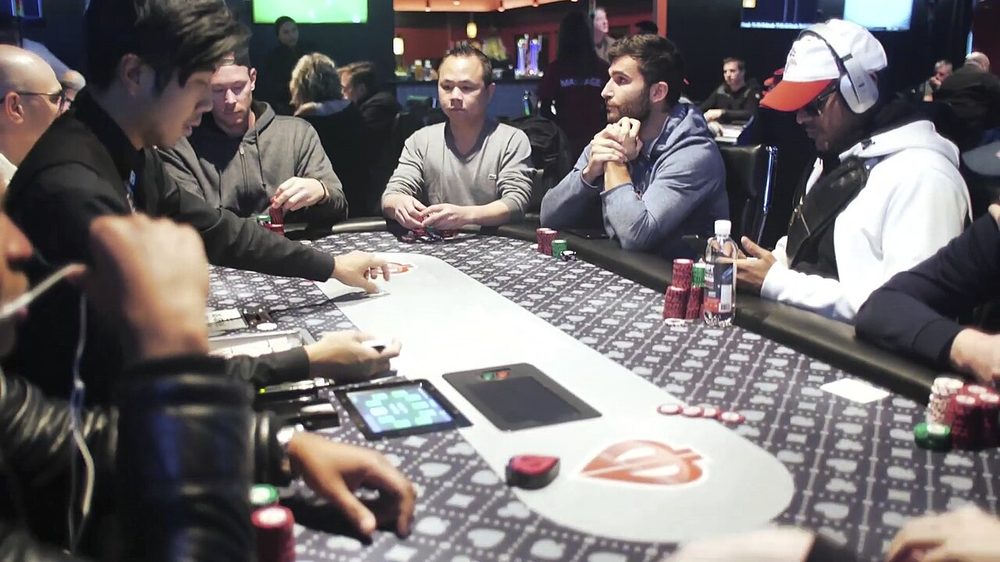
That matters more than it sounds like it should, because poker has always been as much a social performance as a card game. Live poker rooms in Las Vegas, Buenos Aires or Bogotá aren't just venues for hands; they're where the culture of the game actually lives, in the banter and body language that online play strips away. VR is the first digital format with any real shot at bringing some of that back.
Where it falls apart
The honest limits start with the hardware itself. A session of more than 45 minutes to an hour in most consumer headsets introduces fatigue, eye strain or motion discomfort for a meaningful share of users. Poker sessions, live or online, often run far longer than that. A format that physically tires people out faster than the game itself does is working against its own appeal.
There's also the matter of what VR poker is actually simulating. The games built so far have mostly been free-play or play-money products — demonstrations of the technology rather than real-money poker rooms, in part because licensing real-money play inside a VR environment raises the same regulatory questions as any other online gambling product, just with an extra layer of unresolved jurisdictional complexity about where exactly a player sitting in a headset is legally located.
And then there's the simplest problem: most of what makes VR compelling in a demo becomes friction in repeated use. Putting on a headset, calibrating hand tracking, and sitting in a dedicated space are all higher-effort steps than opening an app on a phone. Online poker won its audience partly by removing friction. A technology that adds it back has to offer something substantial in return.
VR poker has to beat the convenience it's giving up, not just the game it's trying to improve.
The hardware curve is real, even if the timeline isn't
None of this means VR poker is a dead end. Headset weight, field of view, resolution and battery life have all improved steadily since the first Oculus Rift shipped in 2016, and that curve hasn't stopped. Meta's Quest line brought the price of entry down from thousands of dollars to a few hundred, which matters enormously for whether any critical mass of players will ever try the thing twice.
Hand tracking without controllers — now standard on recent headsets — is probably the single biggest unlock for poker specifically, since a card game is mostly about hands. The platforms that have invested here, rather than just rendering a nice-looking table, are the ones worth watching. A poker room that requires you to click a virtual button to bet is barely different from a 2D app wearing a headset as a costume. A poker room where you can physically reach out, pick up a chip, and toss it into the pot is doing something a flat screen genuinely cannot.
Audio has gotten better too, and audio turns out to matter more than most of the early VR poker builds assumed. Spatial sound — being able to tell, without looking, that the player to your left just sighed — recreates a piece of the live room experience that visual fidelity alone doesn't.
A niche, and a useful one
We think the realistic outcome sits between the two extremes in the headline. VR poker won't replace the standard online lobby, for the same reason that 3D movies didn't replace the standard theater screen: the format adds real value for a subset of the audience and real cost for everyone else, and most people will choose the cheaper, more convenient option most of the time.
But a niche isn't nothing. There's a genuine audience for whom the social dimension of poker — the part that disappears in a flat online interface — is the whole point. Home game groups who can't get everyone in the same city anymore. Players who miss the texture of a casino room but can't always get to one. People exploring poker history or culture through recreated rooms, rather than playing for stakes at all. For that audience, VR isn't a gimmick; it's the only digital format that even tries to answer what they're missing.
What it's unlikely to become, soon or possibly ever, is the default way most people play poker online. The infrastructure, regulation and hardware adoption required for that are each individually large problems, and VR poker would need to solve all three at once.
What to watch for
- Whether hand-tracking fidelity keeps improving — it's the feature that separates a real innovation from a 3D wrapper.
- How regulators in different jurisdictions treat real-money VR tables, since the legal questions are unresolved almost everywhere.
- Whether headset prices and comfort keep trending toward something closer to a pair of glasses than a helmet.
- Whether any platform builds a genuine live-poker-room social layer, rather than just a prettier table.
The honest answer, for now, is that VR poker is a gimmick that happens to be built on a real and unsolved problem — the loss of presence that came with moving poker online. Whether it ever becomes more than a gimmick depends less on how good the headsets get and more on whether anyone solves the friction that stands between a curious player and a ten-minute demo turning into a habit. We'll keep watching. We're just not holding our chips for it.
If this is your lane, these go deeper: bankroll management and pot odds and equity. For more poker writing in English and Spanish, follow us on Facebook.