 EntrePoker
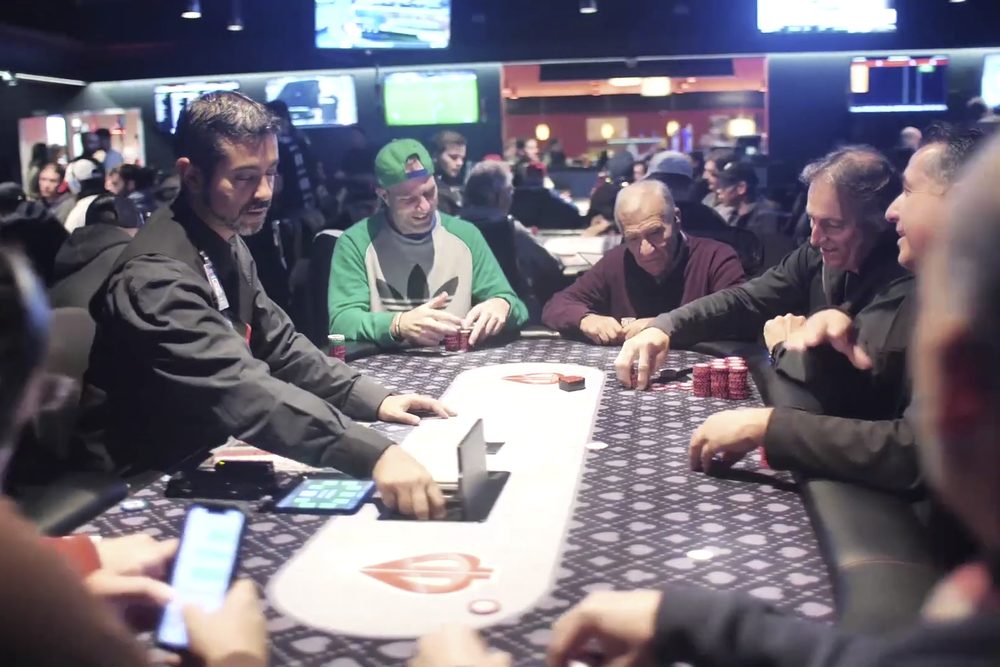
The chips feel different before you've even looked at your cards. Not heavier, exactly, but louder — the stack in front of you suddenly represents three or four buy-ins at your old level, and every player at the table seems to know something you don't. This is the moment a lot of serious poker players know and almost nobody talks about: the first session at a limit you've earned the right to play, feeling like you snuck in through a side door.
We've heard variations of this story from players who moved from $1/$2 to $2/$5, from mid-stakes online tournaments to the next buy-in tier, from a local Buenos Aires club game to a regional festival. The stakes change, the feeling doesn't. It has a name borrowed from organizational psychology — imposter syndrome — and it turns out poker is an unusually good laboratory for studying it, because the game gives you a scoreboard that updates every few minutes.
A feeling with a history outside poker
The term comes from a 1978 paper by psychologists Pauline Clance and Suzanne Imes, who studied high-achieving women who privately believed they'd fooled everyone into overestimating their abilities. The core mechanism they described — success that feels unearned, attributed to luck or timing rather than skill, alongside a quiet dread of being exposed — has since been documented across professions with far less ambiguity than poker: surgeons, academics, airline pilots, software engineers.
What makes poker different is that those professions mostly reward consistency over long, slow feedback loops. A surgeon doesn't get a randomized outcome every ten minutes that may or may not reflect their decision quality. A poker player does. That randomness is exactly what makes the feeling so sticky at the table — and so hard to resolve with logic alone.
Why variance makes it worse, not better
Here is the cruel mechanic of poker that feeds the imposter feeling more efficiently than almost any other competitive activity: in the short run, being right and being rewarded are only loosely correlated. You can make a correct call against a bluff and lose the hand. You can make a bad call and win it. Over thousands of hands this evens out, but a single session at a new stake level is, statistically, nothing — a handful of data points dressed up as a verdict on your worth.
A player moving up in stakes typically experiences more variance in absolute terms, not less, because the bets are bigger even when the relative skill gap with opponents hasn't changed. So the brain, which is very good at pattern-matching and very bad at statistics, reads a losing session as proof of the imposter theory and a winning session as luck that will run out any minute. Both readings confirm the fear. That's the trap.
At a higher-stakes table, the chips aren't measuring your worth — they're measuring your bankroll's tolerance for a game that hasn't finished yet.
What's actually happening at the table
Higher stakes tend to attract a specific social texture that intensifies the feeling even when the opposition isn't actually stronger. Players at $2/$5 often talk differently than players at $1/$2 — more jargon, more table history with each other, more confidence in their body language, some of it earned and plenty of it performed. New arrivals read this atmosphere as evidence of a skill gap before a single hand has revealed anything.
There's also a selection effect working against newcomers' self-perception: the players who've been at a stake level long enough to have a visible routine are, by definition, the ones who survived there. The ones who moved up too fast and lost their bankroll are gone, invisible, no longer part of the sample you're observing. So the table looks more uniformly competent than the level actually is, because failure at that stake is systematically absent from the room.
The two mistakes this feeling produces
- Playing scared: tightening up far beyond what the situation calls for, folding hands that should be played, avoiding the confrontations that define winning poker at any level out of a fear of being seen as wrong.
- Overcorrecting into recklessness: trying to prove belonging by playing more hands, bluffing more often, or taking bigger risks than the stakes or your bankroll justify — mistaking aggression for confidence.
Both responses have the same root: treating the table as a test of identity rather than a sequence of decisions. The healthier players we've watched handle a jump in stakes do something less dramatic than either extreme. They play their normal game, slower, and let the results arrive on their own schedule instead of demanding an early verdict.
What the data actually measures
If there's a genuine fix for this feeling, it isn't a mindset trick — it's a change in what you're measuring. A single session, or even a single night, tells you very little about whether you belong at a stake level. What tells you something is a large enough sample of hands, tracked honestly, including the losing ones, over enough time that variance has a chance to average out. This is tedious advice. It's also the only honest one.
This is also where bankroll management stops being a dry spreadsheet topic and becomes directly relevant to the psychological question. Players who move up in stakes with a bankroll sized for the swings of that level can afford to lose a session without it meaning anything about their skill. Players who move up undercapitalized experience every loss as existential, because in a real sense it is — a short losing streak can actually end their ability to play at that level. The fear, in that case, isn't irrational. It's correctly priced risk disguised as self-doubt.
- Separate the question 'did I play well' from the question 'did I win,' and answer the first one first, hand by hand.
- Track results over a defined, meaningful sample before drawing any conclusion about whether a stake level suits you.
- Treat bankroll sizing as a psychological tool, not just a financial one — undercapitalization manufactures the imposter feeling even in skilled players.
- Notice when the discomfort is about ego versus when it's useful information about genuinely being out of your depth — the two look similar but call for different responses.
A feeling that sometimes tells the truth
We want to be fair to the other possibility, because imposter syndrome as a concept can be misused to wave away legitimate feedback. Sometimes the discomfort at a higher table isn't a distortion — it's an accurate read of a real gap. Moving up in stakes should feel somewhat uncomfortable, because the skill distribution at a new level genuinely does shift, and pretending otherwise is its own kind of denial. The useful distinction is between fear that fades as you gather information and fear that gets confirmed by it.
Poker, unusually among the activities where this feeling shows up, gives you a way to check which one you're dealing with: play long enough, track it honestly, and the numbers will eventually tell you something closer to the truth than your nerves will on any given night.
The players who last at a new level rarely do so because they conquered the feeling in one dramatic sitting. They last because they kept showing up, kept the stakes within what their bankroll and temperament could absorb, and let a large enough sample replace the story they'd been telling themselves about who belonged at that table.
If this is your lane, these go deeper: reading your opponents and cash games vs tournaments. For more poker writing in English and Spanish, follow us on Facebook.